Breaking NEWS

🇺🇸🇮🇷 BREAKING NEWS:

„The declaration of a full-scale jihad against Americans and Israelis would be inevitable should the United States or Israel succeed in launching an attack on Sayyid Ali Khamenei or on Iran,“ declared Ayatollah Sheikh Mohsen Araki.

However, such a „jihad“ will never be declared for an old man who plays no legitimate role in Islam but has usurped the title of Imam. He is a figure who has significantly contributed to inciting Muslims against one another. Not only has he deepened the division between Shiites and Sunnis, but he has driven it to the point where Muslims ultimately took up arms against each other.

This man is the greatest enemy of Islam.

It is especially reprehensible when someone claims to be a Muslim while simultaneously killing Muslims.

The Quran states:

“And whoever kills a believer intentionally, his recompense will be Hell, in which he will abide eternally. Allah will be angry with him and will curse him and prepare for him a great punishment.” (Surah 4, Verse 93)

President Trump, Iran and Israel

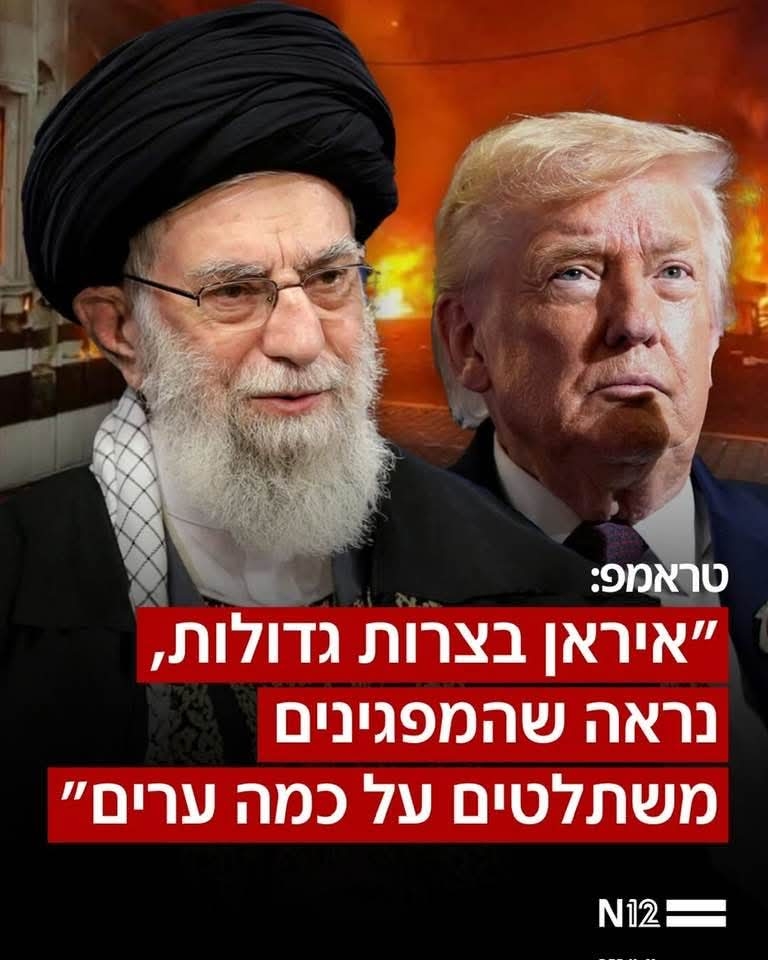
The US president commented again on the unrest in Iran and reiterated his threat: „If they kill protesters, we will take strong action against them.“ However, he clarified: „That does not mean we will deploy soldiers on the ground.“ In Israel, demonstrations are escalating, manifesting themselves in increasing violence. One indication of this is the Revolutionary Guard’s attempt to suppress the protests. Israel is closely monitoring the situation and is careful not to be drawn into a conflict – preferring to leave the leadership to the US.

https://n12.pro/49waIXI

Photo: AP, Reuters

Iran, the Mullah’s and the President’s of the United Staates

We, Emrah Erken, on X

The average Iranian lives on a salary of $223 per month.

In contrast, the mullah regime pays Hezbollah terrorists $1,300 per month, Hamas terrorists $400 per month, and Houthi terrorists $300 per month.

Over $16 billion is spent annually on proxy armies, while almost nothing is spent on the Iranian people.

You might be wondering where the mullahs get this money.

The US under Barack Obama transferred a total of $1.7 billion to the mullah regime in January 2016.

Joe Biden surpassed Obama and transferred $16 billion to the mullahs—the amount the mullahs spend on their proxy armies in a year.

And what did the evil Trump do?

He terminated the nuclear deal with the mullahs, thus ending the mullah regime’s appeasement, much to the dismay of the EU.

Furthermore, he killed the head of the Revolutionary Guard, Qasem Soleimani.

And finally, he gave Israel the green light to destroy the mullah regime’s nuclear facilities, something Biden had refused to allow.

When a Israelite becomes a Jew

Right now, I’m pondering when an Israelite becomes a Jew…

He doesn’t become one through knowledge alone; rather, knowledge must also serve Hashem (the One); and thus, consciousness arises that is based solely on the Torah. It is the unifying force.

Therefore, an Israelite is only a Jew once he has left Mizrajim.

As Jews, it is our duty to remember anew each year that our ancestors were once slaves—and more—it is our duty to empathize with them and relive the Exodus from Egypt each year.

Josef and Jehuda!

The story of Joseph was just read, and he is undoubtedly the central figure. However, I am already thinking about the upcoming Shabbat, because these two parashahs, VaYigash and Vayechi, are not placed directly next to each other by chance. First, Joseph is the focus, then Judah, a week later. If we see Jacob’s legacy and testament in the upcoming parashah—and I do—then behind Jacob’s words lies a clear mandate: the unity of all the tribes, but especially of Judah, the one who always makes a calm judgment, and Joseph, the master of self-control.

It is Joseph and Judah who are the only ones directly addressed in the parashah Vayechi; all the others are addressed indirectly (with the exception of Benjamin). Joseph can always be certain of his father’s deep affection; Judah is the one through whom God’s mysterious plans are fulfilled. It is therefore striking that in Jacob’s final words to his sons, in Judah, Jacob’s poem decisively turns to the future. This is the time in which we live today. All the tribes are present and are characterized with their strengths and weaknesses. This should fill us with joy, for in Judah, all the tribes are represented. Why are all the sons addressed? Because they are the ones who assume a special responsibility for the people and are accountable for the tradition of the Jewish people. It is important to understand that we are speaking of sons, not daughters. These are men who are responsible and who take on their duties. There are exceptions, of course. But this does not mean that Hashem’s will is invalidated; it confirms it.

One does not do justice to Jacob’s poem if one were to read it merely as a characterization of the twelve tribes at a specific point in time. For the final book of the Sefer Bereshit (Beginnings) pursues a fundamental theme: God is the Creator and Ruler of the world and has a special love for Abraham and Sarah and their descendants. The Book of Bereshit is now coming to an end and can be seen as a bridge between past and future. Just a short time ago, we, like the tribes of Israel, were very diverse. But today, the unity of all Jews has never been greater than it is now.

Is Chanukka really over for this year?!!

It’s not so important what people think.

Most have forgotten how. They confuse their opinions with their own thoughts, which lead to actions. The prerequisite for this is an ethical foundation and knowledge. Both have been largely lost in our time.

If these are lacking, then verbal and physical violence are given free rein. This must be kept in check. In civilized societies, this is the responsibility of the state.

Our task, as Jews, is to uphold the Torah as a framework for an ethical and G-d-given life. In this, we are neither dependent on outside influences, nor is this desired.

Conclusion:

We thrive best when left in peace—and we resolutely oppose all others by „globalizing“ the light of Hanukkah, educating ourselves, being taught, learning to discuss, and continuing to practice what we have always done. We take the Torah seriously and bring all the commandments to life in our daily lives. We all learn this differently, as each of us learns at our own pace. But we know that within each of us lies a divine spark that connects us all and makes us aware of how precious our neighbor is to us. Our ever-evolving and growing unity gives us everything we need, for it is to G-d alone that we are accountable.

For me, therefore, Judaism is both an anchor and a civilizational achievement spanning millennia—even today.

Not everyone can say the same.

Chanukka, Light, Jerusalem and the Bet haMikdash

We all need more light through Hanukkah. Join us for the public lighting of the candles in your city or community!

Light is the central theme in the creation story of Hashem. It is a transformative and yet independent existence. Light is always a guide and an attribute of existence. Darkness, on the other hand, has no independent existence and is solely the absence of light. Light is therefore something very precious; for where there is light, there is no room for darkness. One could also say that light is one of the most important creations of Hashem. In Genesis 1:1-2, the creation of heaven and earth is described as a state of desolation, void, and darkness, all „on the face of the abyss.“

This prompts Hashem to act (Genesis 1:3), and God said, „Let there be light,“ and there was light.

Light is an active creative process of God. He calls the light good! (Genesis 1:4)

Only then does He establish the distinction between light and darkness. He called the light day and the darkness night.

Today is another day of Hanukkah. Like Jews and all our friends, we will light another candle and celebrate, despite all the threats of darkness in this world, so that the light may increase and we may remember Solomon’s Temple in Jerusalem together.

Israel is and always will be the land closest to God; it is the land of His people and the place of Bet haMikdash.

Chag Urim Sameach!
Hanukkah Sameach!

Hanukkah!

See through the lights, it’s like in the years when we first came together. See through the lights, a great miracle has occurred. See through the lights, our story in the here and now, and it is true that we can only maintain our unity if we stand together. See through the lights and recognize myself in you. See through the lights and am happy in our togetherness. Even today, it is as it was before. We do not strive for power, for Hashem alone lights our way in the night—of Hanukkah. See through the lights your miracles for us all and thank you for your protection and our paths. Even today we will see each other, and I will carry your blessing with the light. It is already here, and we trust in one another. In the light of Hanukkah!

Chanukka and us

I am prepared for Hanukkah without any particular ambitions and I remember the year 164 BCE when there was neither Christianity nor Islam. It is our duty as Jews to be friendly to Christians who are friendly to Israel. I am not talking about those who, as godless pagans, have draped themselves in a Christian cloak and are now completely discarding it, nor about godless leftists who are making common cause with Muslims to destroy this country.

I will gladly repeat myself: only a self-determined Judaism is a viable Judaism, and to all Christians of goodwill I say:

Had the Maccabees not successfully gone to war with God’s help, Judaism would have been lost forever—and thus the foundation for the emergence of Christianity. In our time, this is where the wheat is separated from the chaff. This also means that only those who adhere to Judeo-Christian values ​​will have a future. Anyone who still believes they can live Christianity without Judaism is a demagogue spreading the biggest lie imaginable.

Therefore, I’m completely relaxed about Hanukkah and hope many friends of Judaism will celebrate with us.

Josef and Hashem

When one examines the Parashah Vayeshev, it becomes apparent that it focuses centrally on the behavior of Joseph’s brothers and initially presents the events from their perspective.

But it begins right at the start with the words, „And Jacob lived in the land of his father’s residence, the land of Canaan.“

Then Joseph is introduced, the shepherd, a son whom Jacob had in his old age and whom he loved dearly. Jacob is the one who makes him a colorful robe. As a result, the brothers felt slighted and began to hate Joseph. When Joseph begins to recount his dreams, they hate him even more.

Interestingly, these events only indirectly address the brothers‘ responsibility for their own behavior. Rather, they rebel against their father Jacob and attempt to resolve the resulting conflict by projecting their negative feelings onto Joseph. He had not chosen to be especially loved. Joseph speaks openly about his dreams, and his brothers suspect that he might be seeking special treatment from them. This isn’t the case. He’s simply different. While the brothers are constantly close, creating a strong group dynamic, it is Joseph who is sold by the Medanim to Potiphar, Pharaoh’s chief bodyguard, in Mizraim.

Of course, Joseph’s life continues, even though the circumstances are dire. In chapter 39, Joseph is freed from the hands of the Ishmaelites who had taken him there.

Now our Torah refers directly to Hashem. For it says in the second verse: „And the Lord was with Joseph, and he prospered in everything he did; and so he was in the house of his master, the Mizri.“

So Joseph’s life takes place not in Eretz Yisrael, but in Mizraim.

But read on for yourself. One sentence is particularly important to me. After Joseph was imprisoned, it says… „And the Eternal One was with Joseph and showed him mercy and showed him favor in the eyes of the jailer.“

I learn from this that God often works indirectly and positively on our lives through others who are not our friends or even our close acquaintances. And it occurs to me that everything is subject to the will of the Eternal One, even if life’s dramas initially seem to suggest otherwise. For it is God alone who directs, and it is we as individuals who contribute our abilities, believe in Him, and are accountable to Him.

Shavua Tov