
MACA—Make America Conservative Again. President Trump is losing control over the political future of the Republican Party. The midterm elections will center entirely on the President. It is to be expected that he will lash out at the EU to portray himself as the guardian of American economic interests. This move could backfire, however; threats of 100 percent tariffs against the EU over the new digital tax law cannot mask the total failure in handling Iran and allies in the Middle East. President Trump is not only losing control of political events regarding the conflict with Iran—he also risks being punished at the polls in the next election. That would mark the swan song of a presidency that began with such promise just a few years ago. The Republicans will need to regroup—aligning with figures like Rubio and the many patriots who can no longer follow Trump’s path. Those who wish to secure a new mandate and a resurgence for the Republican vision of a blessed America will not choose socialist Democrats; instead, they will opt for a more moderate Republican course—one clearly grounded in God, the Constitution, and Israel. If this vision is clearly articulated by the end of the term, then electoral success—bringing a blessing to the many in the U.S. who strive for peace and stability—will be assured.
Autor: Marcus Gundlach
Blogger (marcusgundlac12) and Poet, jewish, early-retired Socialworker
Mein Verständnis zu Henryk M. Broder ist kongruent!
»Es ist völlig irrelevant, wie viele der 1,6 Milliarden Muslime sich in die Luft gesprengt haben. So, wie es irrelevant ist, wie viele Deutsche ein Parteibuch der NSDAP hatten. Oder wie viele als IM der Stasi zugearbeitet haben. Das Einzige, worauf es ankommt, ist, dass so gut wie alle, die sich in die Luft gesprengt haben und dabei andere mitgenommen haben, es mit dem Ruf „Allahu akbar!“ taten. Oder fällt Ihnen einer ein, der „Gelobt sei Jesus Christus!“ oder „Baruch ha’Schem!“ gerufen hat, während er die Leine zog? Es ist mir übrigens völlig egal, seit wann in islamischen Ländern gesteinigt wird. Es zählt nur, dass es heute gemacht wird, in Anwesenheit von Menschen, die mit einem Bein in der Barbarei und mit dem anderen in der Moderne stehen und die Steinigungen mit ihren Handys filmen.
Ich verweigere jede Art von Verständnis für diese Art von Kultur. Ich will sie auch nicht importieren. Ich will keine Debatten führen über Kopftücher im öffentlichen Dienst, über Schwimmunterricht für Mädchen, über Männer, die Frauen keine Hand geben wollen, über Schweinefleisch in Kantinen und „kultursensible Pflege“ in Krankenhäusern. Und auch nicht darüber, wie viel Islam im Islamismus steckt. Ich will auch nicht genötigt werden, mich mit dem Koran zu beschäftigen, weder von weiß gewandeten Salafisten in der Wilmersdorfer Straße noch von Ihnen. Bleiben Sie bei Ihrer Wertschätzung für das „klassische islamische Recht“, das offenbar von den Kolonialherren versaut wurde. Und sobald Sie den Islam gefunden haben, der mit Demokratie kompatibel ist, sagen Sie mir bitte Bescheid.«
Henryk M. Broder im Streitgespräch mit Eva Marie Kogel, WELT, 20. 07. 2016. Quelle im ersten Kommentar.
Die Ursprünge des Namens „Palestina“
Die Ursprünge des Namens „Palästina“ entdeckte ich zuerst bei Loahnah Heike Wiederkehr – einer Gerechten.
Einer der Begriffe, der in Ihren morgendlichen Nachrichten am häufigsten vorkommt, ist „Palästina“. Aber was bedeutet er eigentlich? Woher stammt dieser Name? Werfen wir einen Blick in die Geschichte.
Die Bibel erzählt viele Geschichten von Kriegen zwischen den Israeliten und den Philistern, einem Volk von Eindringlingen (von der hebräischen Wurzel PLSH, was „eindringen“ bedeutet). Die Philister waren griechischen Ursprungs, wahrscheinlich aus dem Ägäischen Meer. Die Heilige Schrift beschreibt sie als Seefahrer, die sich entlang der Südküste des alten Israel in Städten wie Gaza, Aschkelon, Aschdod, Ekron und Gat niederließen.
Sie waren die erbitterten Feinde Israels und befanden sich ständig im Krieg mit den Hebräern (ein bekannter Kampf ist der zwischen Simson und Delila; Delila war eine Philisterin). Ihre Geschichte endet im Jahr 604 v. Chr., als sie von den Neobabyloniern vollständig vernichtet werden, nachdem sie bereits im Jahr 1000 v. Chr. durch König David geschwächt worden waren. Danach verschwinden die Philister aus der Geschichte. Es sind keine Spuren ihres Volkes, ihrer Kultur oder ihrer Sprache erhalten geblieben.
700 Jahre später, während des Römischen Reiches, führt der jüdische Anführer Bar Kochba einen heldenhaften Aufstand gegen die römische Herrschaft an und scheitert tragischerweise. Um die Verbindung der Juden zu diesem Land auszulöschen, benennen die Römer „Judea“ in „Syria Palaestina“ um und beschwören damit bewusst die Erinnerung an Israels alte Feinde, die Philister, herauf. Sie vertreiben den Großteil der jüdischen Bevölkerung und zerstören Jerusalem.
Der Name „Palästina“ bleibt bestehen und taucht in den nächsten 1.800 Jahren auf Karten auf, jedoch nur als geografische Bezeichnung, niemals als Name einer Nation oder eines Volkes.
Im Laufe der Jahrhunderte bleibt das Land dünn besiedelt und weitgehend öde und wechselt von einem Reich zum nächsten: Byzantinisches, Arabisches, Mamluken- und Osmanisches Reich. Im Jahr 1869 besuchte Mark Twain das Land und beschrieb, was er sah:
„Ein ödes Land, dessen Boden zwar fruchtbar genug ist, aber gänzlich dem Unkraut überlassen ist … Wir sahen auf der gesamten Strecke keinen einzigen Menschen … Es gab kaum einen Baum oder Strauch.“
Im 19. Jahrhundert war die Bevölkerung der Region klein und gemischt: Juden, Christen, Beduinenstämme und arabischsprachige Dorfbewohner, die sich nicht als „Palästinenser“, sondern als Syrer oder einfach als Araber unter osmanischer Herrschaft identifizierten. Der Begriff „Palästina“ wurde von europäischen Kartographen verwendet, nicht von den Einheimischen.
Unter der frühen islamischen Herrschaft wurde die Al-Aqsa-Moschee auf den Ruinen des jüdischen Tempels errichtet, als Symbol für die islamische Eroberung und die Ablösung der jüdischen Verbindung zu diesem Ort. Doch das jüdische Leben verschwand nie. Über die Jahrhunderte hinweg bestanden Gemeinden in Jerusalem, Hebron, Safed und Tiberias fort.
Wer sind also die modernen „Palästinenser“? Als die zionistische Bewegung Ende des 19. Jahrhunderts begann, kehrten Juden aus aller Welt in ihre alte Heimat zurück, erwarben legal Land, legten Sümpfe trocken und belebten die Landwirtschaft wieder. Dies brachte wirtschaftliche Chancen mit sich, und arabische Migranten aus den umliegenden Regionen – Ägypten, Syrien, dem Libanon und Transjordanien – zogen auf der Suche nach Arbeit in das Gebiet.
Die Briten, die nach dem Ersten Weltkrieg die Kontrolle übernahmen, bezeichneten alle Menschen in der Region, Juden wie Araber, als „Palästinenser“. Tatsächlich waren die „Palestine Post“ (die heutige Jerusalem Post) und das Palestine Philharmonic Orchestra jüdische Institutionen.
Erst nach der Gründung des Staates Israel im Jahr 1948 und der arabischen Niederlage (als sie das Land verloren und zu Flüchtlingen wurden) begannen lokale arabische Führer, sich selbst als „Palästinenser“ zu bezeichnen, und übernahmen damit den römischen Namen, mit dem einst das jüdische Volk verspottet worden war.
Was einst eine römische Beleidigung war, wurde zu einer modernen politischen Identität, die erst Mitte des 20. Jahrhunderts entstand.
English Translation:
The Origins of the Name „Palestine“
One of the terms that appears most frequently in your morning news is „Palestine.“ But what does it actually mean? Where does this name come from? Let’s take a look at history.
The Bible recounts many stories of wars between the Israelites and the Philistines—a people of invaders (from the Hebrew root PLSH, meaning „to invade“). The Philistines were of Greek origin, likely hailing from the Aegean Sea. Scripture describes them as seafarers who settled along the southern coast of ancient Israel in cities such as Gaza, Ashkelon, Ashdod, Ekron, and Gath.
They were Israel’s bitter enemies and were constantly at war with the Hebrews (a well-known conflict is that between Samson and Delilah; Delilah was a Philistine). Their history comes to an end in 604 BC, when they were completely annihilated by the Neo-Babylonians—having already been weakened by King David around 1000 BC. Thereafter, the Philistines vanish from history. No traces of their people, their culture, or their language have survived.
Seven hundred years later, during the era of the Roman Empire, the Jewish leader Bar Kokhba led a heroic uprising against Roman rule—which, tragically, ended in failure. In an effort to obliterate the Jews‘ connection to this land, the Romans renamed „Judea“ to „Syria Palaestina,“ thereby deliberately invoking the memory of Israel’s ancient enemies: the Philistines. They expelled the majority of the Jewish population and destroyed Jerusalem.
The name „Palestine“ endured, appearing on maps over the next 1,800 years—yet solely as a geographical designation, never as the name of a nation or a people. Over the centuries, the land remained sparsely populated and largely desolate, passing from one empire to the next: the Byzantine, Arab, Mamluk, and Ottoman Empires. In 1869, Mark Twain visited the land and described what he saw:
“A desolate country, whose soil is rich enough, but is entirely given over to weeds… We saw not a single human being on the whole route… There was hardly a tree or a shrub.”
In the 19th century, the region’s population was small and mixed: Jews, Christians, Bedouin tribes, and Arabic-speaking villagers who identified themselves not as “Palestinians,” but as Syrians or simply as Arabs under Ottoman rule. The term “Palestine” was used by European cartographers, not by the local inhabitants.
Under early Islamic rule, the Al-Aqsa Mosque was built upon the ruins of the Jewish Temple as a symbol of the Islamic conquest and the superseding of the Jewish connection to the site. Yet, Jewish life never vanished. Throughout the centuries, communities persisted in Jerusalem, Hebron, Safed, and Tiberias.
Who, then, are the modern “Palestinians”? When the Zionist movement began in the late 19th century, Jews from all over the world returned to their ancient homeland, legally acquired land, drained swamps, and revitalized agriculture. This brought with it economic opportunities, and Arab migrants from surrounding regions—Egypt, Syria, Lebanon, and Transjordan—moved into the area in search of work.
The British, who assumed control after World War I, referred to all people in the region—Jews and Arabs alike—as “Palestinians.” Indeed, the Palestine Post (today the Jerusalem Post) and the Palestine Philharmonic Orchestra were Jewish institutions. It was only after the founding of the State of Israel in 1948 and the Arab defeat—when they lost the land and became refugees—that local Arab leaders began to refer to themselves as „Palestinians,“ thereby adopting the Roman name that had once been used to mock the Jewish people.
What was once a Roman insult evolved into a modern political identity that emerged only in the mid-20th century.
.
Jerushalajim!
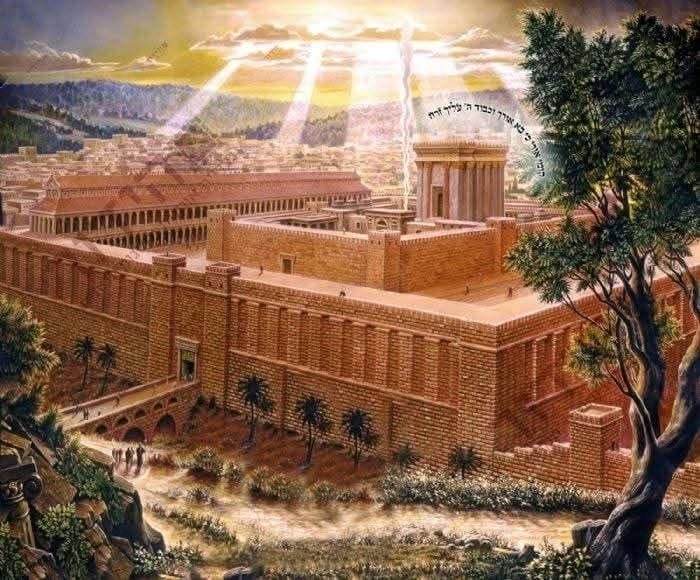
At this moment, I am thinking of Yerushalayim and Jerusalem Day, which is being observed this evening and tomorrow.
It celebrates the recapture of Jerusalem—its liberation, its reunification, and the vibrant religious life available to all Jews and all other people who have committed themselves to three things:
Truth, Justice,
and Peace.
Jerusalem is uniquely blessed by Hashem, the God of Israel; it is a place where we all belong—at least once in our lives.
It is the City of God—not merely the deity of some church or a desert demon—but a truly holy city.
Therefore, it is Israel alone that guarantees that all monotheists of this world may—and indeed have the right to—find their spiritual center here.
Once the Third Temple has been fully rebuilt—and this will come to pass sooner than many fear or oppose—then all offerings will be brought in the proper place for the sake of the world, and the world will come to understand why this is the will of Hashem.
Path of my Life
I am currently studying the Parashah „Emor.“
Two sources have particularly caught my attention. In the Midrash (Pirke deRabbi Elizer), there is a reference to the three pilgrimage festivals that are central to the Parashah „Emor“ corresponding to the three regalim (patriarchs). Abraham is associated with Passover, Isaac with Shavuot, and Jacob with Sukkot.
In the Hasidic commentary „Sfat Emet,“ the three festivals correlate with the three qualities that are required of us daily in our service to God: namely, „with all your heart, all your soul, and all your ability“ (Deuteronomy 6:5).
At this point, I would like to cite Shim’on haZaddik and Shim’on Ben Gamli’el. They state that the world rests on three things:
On learning, on work, and on charity.
The world rests on three things:
Truth, justice, and peace.
A Mishnah of Sayings of the Fathers states that the world rests on three regalim (foundations, legs): service to God, Torah, and charity.
When these statements are linked, the following picture emerges:
Abraham served God with his whole heart, which is expressed in his service to God („Avodah“) and at Passover; Isaac with his whole soul, with Torah, at Shavuot; and Jacob with Gemilut Chesed, at Sukkot.
All three are interconnected and influence one another. Therefore, Abraham is my great role model, Isaac is the person I see myself reflected in, and Jacob is the person to whom I owe my allegiance.
Jacob-Israel is the patriarch of all the tribes that make up Israel, and he is also the one who, on his deathbed, uttered and passed on the Shema Yisrael as a reminder and command to his sons.
Now the time of Lag b’Omer is near, and we continue counting down the days until Shavuot, which will then be celebrated as Matan Torah, the Receiving of the Torah.
For me, all of this is a very personal experience and not simply an important event.
That is precisely why I walk the path of my life with our Torah, and I don’t forget that next year I will again celebrate my birthday on the eve of the Seder (the 13th of Nissan), and if God wills, then even with friends in a synagogue, and I will also visit a mikveh.
Shavua Tov
Am Jisrael Chai!
Today Israel celebrates the
78th anniversary of its independence—this is not something we ask for, but a fact we defend.
Israel has a 3,000-year history, and this history is continued by all Jews.
Today I am happy, because Israel is the guarantor of peace, freedom, and self-determination.
The Jewish people live!
Am Jisrael Chai!
Important Warning!
From the Israeli Embassy:
Please share this with your Jewish networks. The Israeli Embassy has asked us to share the following message with the community:
Dear friends,
Right now, a website is circulating that claims to help Jews living abroad:
This website collects information about Jewish and Israeli families abroad and invites people to „host Jews and Israelis.“
There is a serious suspicion that this site is operated by hostile entities seeking to identify and harm Jewish and Israeli families.
Under no circumstances should you provide personal information on this website!
Stay away and spread this message: do not use this site and rely only on official channels of the Israeli government, the Ministry of Foreign Affairs, and its embassies. In case of urgency or emergency, you can contact the Ministry of Foreign Affairs‘ 24-hour Situation Room:
- Telephone: +972-2-5303155
- Fax: +972-2-5303896
- Email: matzav@mfa.gov.il
Please forward this message; it could save lives.
My favourite Parasha;WaJeze – in these times and today!
At this time I am studying our Torah, to be prepared for Shabbat. Its about Parasha WaJeze.
The parasha WaJeze is so named because Yaakov left Beersheba. There are different emphases in translations as to how WaJeze is to be understood. Personally, I prefer the interpretation of ‚approaching something‘. For me personally, it is the most important parasha in my life as a Jew.
Jacob goes to a place that the Torah only refers to indirectly… „and came to that place“. And yet everything is clear, as we will learn in the course of the further interpretation of the words of the Torah.
It is Jacob who leaves his familiar surroundings and takes one of the stones of the place for his head and lies down. It is a hard surface that Jacob chooses. On the one hand, this is his decision, and on the other hand, he does not make it easy for himself – quite deliberately.
Then he has his famous dream with the ladder reaching up to heaven. Messengers of G-d (plural) ascend and descend on it. These messengers are a clear indication of things to come. Then Jacob has a vision of G-d. G-d speaks to Jacob. Hashem promises him and his seed (i.e. descendants), that is, Israel as a whole. For Hashem says that all the clans of the earth will be blessed in him and spread out. Hashem clearly says, „I am with you, I will guard you wherever you go, and I will bring you back to this land, yes, I will not leave you until I have done what I have spoken to you.“
…
Which place does the Torah describe in this event? It is Mount Moriah, today’s Temple Mount! G-d is everywhere, but He does not reveal Himself everywhere.
When Jacob awakens, everything is strange to him, yet clear. He takes the stone on which his head rested and erects a monument with it, which he pours oil over. It is this symbolic act that sanctifies the profane and makes a decisive difference. He calls this place Bet-El, House of G-d. This refers to the Temple in Jerusalem.
Then he makes a vow. He formulates his words (in chapter 28, verse 20) not as a demand, but as a condition and logical prerequisite. …
But study and read every detail of the Parasha for yourself. I have always seen it as my duty never to lose my faith, even in exile. And I do not, because only in this way can I serve God and return to the house.
Shavua Tov.

Awraham
Abrahams Haus
stand allen Menschenkindern offen,
den Vorbeiziehenden,
Heimkehrenden,
und Tag für Tag kamen welche,
um bei Abraham zu essen und zu trinken.
Wer hungrig war,
dem gab er Brot.
Wer nackend in sein Haus kam,
den hüllte er in Kleider
und ließ ihn von Gott erfahren,
dem Schöpfer aller Dinge.
(Micha Josef Bin-Gurion
in „Sagen der Juden“, Berlin 1935)
Poetry in a lost World or Laugh and Sing
Shine on in writing
a climpse of freedom
in our Hearts
The new year will bring back our speech
without fears
Kindly and focused
on Good and G-d
We became
scrambled down
the falling was deep
While we wait at our time
To Love and Write
Touching Souls
uncensored Voices
Never forget our friends
Who died at a wall of lies
and the full ignoration of our Lives
Life, Freedom, Woman
Our Power is not buried
To laugh and sing

